
wo players. Same position. Same height. One collapses after 60 minutes;the other sprints into the 85th minute like it's a warm-up. The difference often comes down to a single number: VO2 max. In football, this isn't just a lab metric—it's the engine that drives repeated high-intensity efforts. The VO2 max football test, most commonly the Yo-Yo Intermittent Recovery Test Level 1, remains the most practical way to measure that engine without a treadmill.I've watched academy coaches argue over GPS data for hours, yet the Yo-Yo test still cuts through the noise. The protocol is simple: 2×20-meter shuttle runs at increasing speeds, with a 10-second active recovery between bouts. Players must keep pace with audio cues. The test ends when a player fails to reach the line twice in a row. The distance covered is then used to estimate VO2 max. A midfielder covering 2。200 meters?
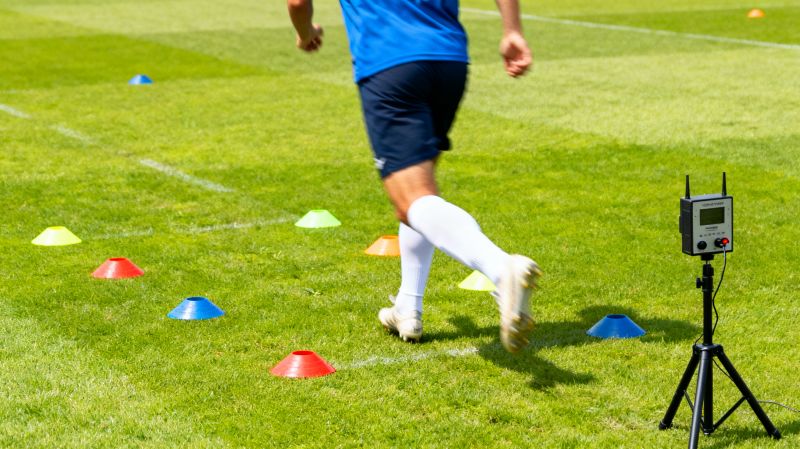
That's roughly 56 ml/kg/min. A winger hitting 2,600 meters?Closer to 62. These numbers aren't abstract—they correlate with how quickly a player recovers between sprints and how well they maintain technical sharpness under fatigue.Critics say the test is too generic. Fair point. A center-back doesn't need the same aerobic capacity as a box-to-box midfielder. But that's exactly why the VO2 max football test works as a baseline, not a final verdict. I remember a League One fitness coach telling me he once had a striker score poorly on the Yo-Yo test—1,800 meters—yet the player consistently won games with late runs into the box. The coach didn't drop him. He paired the test result with video analysis and found the striker's efficiency in short bursts was elite. The lesson: don't treat the number as a death sentence. Use it to design individual conditioning blocks.How should coaches actually implement it?Twice per season—once at the start of pre-season, once mid-season. Running the test on a Monday after a Saturday match is pointless;
fatigue skews results. I prefer Wednesday mornings。after a recovery day. And forget testing on artificial turf in 30°C heat. The same player can lose 200 meters in those conditions. Record the ambient temperature and surface type alongside the score. That context matters more than the raw number. A 2,000-meter result on a cool, natural grass pitch tells a different story than the same score on a hot, dry artificial surface.What about the future?GPS vests now estimate VO2 max in real time during small-sided games, and some clubs are moving away from formal testing. That's a mistake. The Yo-Yo test forces players to confront their limit in a controlled, repeatable setting. You can't fake it, and you can't hide behind possession stats. For all the tech。
a simple shuttle run still reveals who did the summer work and who didn't. I'd keep it in the battery. Not because it's perfect, but because it's honest.